Showing posts sorted by relevance for query Stories from Camp Frederick. Sort by date Show all posts

Friday, October 27, 2023

Stories from Camp Frederick: German World War II POWs in Frederick, Maryland, Part 4

October is German-American Heritage Month and one of the topics I'm contacted about frequently is the history of German World War II POW camps in Maryland. I studied German and History at Hood College in Frederick, Maryland, where I researched and have subsequently written several articles and papers on this topic. This article series has been shared over the course of four weeks, ending this week with the "Conclusion" and "Bibliography." Variations of this article series have appeared in Frederick Magazine, German-American Journal, and on the German Pulse website. I look forward to resharing it now, with revisions, and keeping this dialogue, research, and these stories alive:

Conclusion

Through the summer of 1945 to the spring of 1946, most of the German POWs in Maryland were sent back to Fort Meade, and eventually, home. Almost all of the 32,800 prisoners in the tri-state area were gone by August of 1946, except those who had violated military law or were in the hospital. An article from the Frederick News-Post from November 29, 1945, suggests that the camp may have had plans to shut down earlier, but had decided to remain open at least until January 1, 1945, after “work contracts for the use of some 200 Germans had been renewed for 30 days.”

Photo by former camp guard Charles P. Wales of Frederick P.W. Camp #6,
also known as Camp Frederick. Read more here. 
Not long after the POWs were gone, an auction occurred at the campsite on May 23, 1946, and over $4,500 was raised from the sale of the camp’s buildings and other salvaged materials. The Frederick Co-op Association was already at work restoring the site to its original farm field conditions.

Already on November 14, 1946, former POW Peter Siegfried Muetzel wrote to Quynn Orchard in Frederick, “requesting a copy of a picture of him and three friends taken November 1945 in Frederick.” At the time the letter was written, Muetzel was serving as a POW in an English camp, but wrote of wanting to return to the United States someday, where he had seen the Ringling Brothers Circus with his parents prior to the war.

Ironically, some of the prisoners had visited the United States before the war and even had relatives or friends who had settled in the area in previous generations. Frederick itself was settled by Germans more than 250 years ago, and now these young men who had ties of various kinds to the area or this country were being held there as prisoners. On the other side, enemy soldiers—who had fought for a government responsible for some of the most horrible atrocities in history—seemed to be inundating Frederick. Personal accounts from both sides paint a picture that, while distrust and fear were present on both sides, these soon gave way to curiosity, friendship, and mutual benefits of various kinds.

As stated before, this may not have been true of all POW camps across the United States during World War II and certainly does not reflect the horrific treatment of Japanese Americans incarcerated at internment camps around the same time. For the purposes of this article and research, it appears that the life of a German POW at Camp Frederick may have been marked by some degree of ethnic and racial privilege. Ultimately, under the circumstances, it seems the contact between German POWs and American soldiers and civilians in the small city of Frederick, Maryland, demonstrated to both sides the importance of viewing their “enemies” as people like themselves.

Bibliography

Brooks, Nelson. “POW Camp Revisited 20 Years Later,” The Post (February 17, 1967): 21.

Burdette, Dolly M. “Remembers local WW II POW camp and its prisoners,” Frederick News-Post Online, http://www.fredericknewspost.com/sections/display.htm?StoryID=32630; accessed 16 February 2004.

Conn, Elizabeth. “Local Responses: Excerpts from the Richard Lebherz World War II Letters Collection,” The Journal of the Historical Society of Frederick, Maryland (Spring 2007): 44-49. 

“County Residents Recall Camp For POWs Here,” Frederick County Historical Society (February 16, 1967): 1, 5.

Doxzen, Duane. “A Brief History of Frederick’s Prisoner of War Camp,” The Journal of the Historical Society of Frederick, Maryland (Spring 2007): 34-43.

“50 years ago: January 4, 1945,” Frederick News-Post (January 4, 1995).

“50 years ago: November 29, 1945,” Frederick News-Post (November 29, 1995).

“50 years ago: May 23, 1946,” Frederick News-Post (May 23, 1996).

“50 years ago: November 14, 1946,” Frederick News-Post (November 14, 1996).

Fortney, Sarah. “Frederick’s POWs,” Frederick News-Post (January 15, 2007): A1, A12.

Gillis, Christopher C. “A German P.O.W. Remembers Camp Frederick,” Frederick Magazine (November 1992): 8-9.

Grosvenor, Sara. “Former POW returns for visit,” Frederick News-Post, Frederick (July 30, 1980): A-3.

Hammond, Helen. “Remembering World War II: The year the Nazis came to Frederick,” Frederick Magazine (June 1996): 28-31.

Hershberger, Mayetta. Letter to Richard Lebherz, Frederick County Historical Society (October 4, 1944).

Holl, Richard E. “Axis Prisoners of War in the Free State, 1943-1946,” Maryland Historical Magazine 83, no. 2 (Summer 1988): 142-156.

Lebherz, Richard, Letter to his parents, Frederick County Historical Society (December 11, 1944).

“‘Lost’ Prisoner Camp Was Located Near City,” Frederick County Historical Society (February 16, 1967).

Maryland in WWII, Volume I: Military Participation. Baltimore, Maryland: War Records Division, Maryland Historical Society, 1950.

May, George. “Where, Oh Where, Was That German POW Camp?” The News (February 15, 1967).

“POW Camp Near City Part Of Fort Meade,” Frederick County Historical Society (February 18, 1967).

Pugh, Caroline Tatum. “Remembering the ‘Frederick Hilton,’” Frederick Magazine (June 1996).

Spaur, Michael L. “What’s in the Name? Old Camp Road,” The Post (August 30, 1979): B-10.

Thomas, Mrs. B.O., Sr. Letter to Richard Lebherz, Frederick County Historical Society (September 26, 1944).

Thomas, Mrs. B.O., Sr. Letter to Richard Lebherz, Frederick County Historical Society (November 9, 1944).

Wales, Charles P. “P.W. Branch Camp #6: A Photo Essay,” The Journal of the Historical Society of Frederick, Maryland (Spring 2007): 4-33.

“War Prisoners Wouldn’t Work: Those Here Put on Bread, Water Diet,” Frederick County Historical Society (September 10, 1944).

Waters, Ed, Jr. “A POW camp near U.S. 40A,” Frederick News-Post (February 2, 2004): 12, 16.

"Stories from Camp Frederick: German World War II POWs in Frederick, Maryland," copyright 2023 Amelia Cotter (variations of this article series first appeared in Frederick Magazine and German Pulse in 2012, and in German-American Journal in 2009)

Friday, October 6, 2023

Stories from Camp Frederick: German World War II POWs in Frederick, Maryland, Part 1

October is German-American Heritage Month and today is German-American Day! One of the topics I'm contacted about frequently is the history of German World War II POW camps in Maryland. I studied German and History at Hood College in Frederick, Maryland, where I researched and have subsequently written several articles and papers on this topic. This article series will be shared over the course of four weeks, beginning this week with "Introduction" and "Fort George G. Meade and the Maryland POW Camp System," and continuing next week with "Life in the POW Camp" and "POWs at Camp Frederick." Variations of this article series have appeared in Frederick Magazine, German-American Journal, and on the German Pulse website. I look forward to resharing it now, with revisions, and keeping this dialogue, research, and these stories alive:

Introduction

During World War II, the United States established its largest prisoner of war (POW) program in its history. By May of 1945, over 425,871 Axis prisoners were being held in POW camps across the country. Of these, 372,000 were German.

Frederick County was home to one POW camp, exclusively holding Germans. There are many newspaper and magazine articles, personal letters, and firsthand accounts concerning the men who lived and worked at Camp Frederick, officially PW Branch Camp #6, which was located on what is now Old Camp Road, just northwest of the city of Frederick.

Guard tower at Fort Meade's internment-turned-POW camp.
Photo courtesy of The Baltimore Sun.
At Camp Frederick, prisoners were primarily employed in agriculture, on privately owned farms, and mostly as apple pickers. Some were also contracted out to commercial companies, such as the Oxford Fibre Brush Company, where they loaded and unloaded lumber. In essence, the POWs performed the tasks that no one else could do, due to the severe labor shortages as a result of the war.

This article will focus primarily on the lives and experiences of the men at Camp Frederick and, although the information available is mostly one-sided, and most of the viewpoints are American, the idea that Camp Frederick ran relatively smoothly with little unrest or injustice is accepted here. Most likely not all POWs across the United States had a similar experience, but personal accounts from both locals and prisoners paint a picture that Camp Frederick was a relatively agreeable and humane place for a POW to be held captive during World War II.

The stories and experiences of both the prisoners and members of the Frederick community are varied and surprising. It appears from their descriptions that several of the POWs in Frederick left the country having had a positive experience and warm memories.

The citizens of Frederick felt undoubtedly afraid of and ambivalent towards their enemy guests, but nevertheless, many of them found friendship and even lifelong relationships with some of the prisoners. Meticulously collected and continually revisited by the media over the decades, the articles, letters, and firsthand accounts of the prisoners and those that lived in Frederick reveal a very real, human, and personal side of the war, in many cases breaking down both German stereotypes and misconceptions about American nationalism.

Fort George G. Meade and the Maryland POW Camp System

In Maryland, the POW camp program was initially developed in three overlapping phases: planning for security and escape prevention, how to benefit from the work of the POWS, and developing a program of political rehabilitation. In the first stage, which lasted from December 1941 to the end of 1943, the provost marshal’s office of the War Department—which was in charge of the national POW program—established that one guard would need to supervise every two or three prisoners. The office was largely concerned with escape attempts and prisoners becoming hostile towards guards and each other. This explains why it spent so much time deliberating on this phase and creating a tight security policy.

It was during this stage that the provost marshal’s office of the War Department established its Maryland installation at Fort George G. Meade, located in the juncture of Anne Arundel, Howard, and Prince George’s counties. Fort Meade received permission to start holding prisoners on September 15, 1942, and initially held Axis-country civilians who were trapped in the U.S. after the war erupted.

Starting in September 1943 to July 1946, Fort Meade served as the main POW camp in Maryland with a capacity of 1,680 prisoners. When it officially became a POW camp in 1943, Fort Meade held mostly Italians and only a few German POWs, until May 1944 when it officially became a German POW camp. Most of the POWs captured and brought to Maryland were Wehrmacht (army) personnel, though there were also some soldiers from the Luftwaffe (air force) and the navy.

Around 1943, pressure began to build on the War Department to loosen up its harsh POW security policies. Local farmers, businesses, and manufacturers—due to extreme labor shortages—began to suggest that the POWs be allowed outside of Fort Meade to work for them.

As a result, in June 1943 authorization was given to Fort Meade for limited agricultural employment, but the War Department was unwilling to allow the soldiers outside of the camp. Five months later, as desperation for workers continued to grow, approval was given for the establishment of new German POW camps in Maryland. In February 1944, at a military-civilian conference held in Dallas, Texas, the War Department formalized the change in its security policy and the construction of 18 additional POW camps began.

These camps would employ workers in various agricultural and industrial activities in Maryland under the terms of the Geneva Convention, which stated that “captured enemy officers could not be compelled to work and that non-commissioned officers could only supervise.” Enlisted men could work any job except one “demeaning, degrading, or directly related to the war effort.”

Not only did the Geneva Convention not allow forced labor, but prisoners at Camp Frederick were considered Class A prisoners, meaning all work was to be voluntary. According to Charles P. Wales, who served as a guard at Camp Frederick from September 1945 to Spring 1946, many of the prisoners who decided to work outside the camp were prompted by boredom.

By August of 1945, over 4,000 POWs in Maryland were laboring for the army or navy, and 6,000 for civilian contractors. Most prisoners worked within the camps at camp bakeries, canteens, hospitals, or laundries. Others dug ditches, built roads, and managed lawns. Farmers could apply for the extra prisoners through the Department of Agriculture’s War Food Administration, while manufacturers had to go through the War Manpower Commission to receive prisoner labor. In Frederick, the Frederick County Agricultural Cooperative Association was formed in 1944 to “tap into the pool of available prisoner labor.”

"Stories from Camp Frederick: German World War II POWs in Frederick, Maryland," copyright 2023 Amelia Cotter (variations of this article series first appeared in Frederick Magazine and German Pulse in 2012, and in German-American Journal in 2009)

Thursday, October 12, 2023

Stories from Camp Frederick: German World War II POWs in Frederick, Maryland, Part 2

October is German-American Heritage Month and one of the topics I'm contacted about frequently is the history of German World War II POW camps in Maryland. I studied German and History at Hood College in Frederick, Maryland, where I researched and have subsequently written several articles and papers on this topic. I'm sharing this article series over the course of four weeks, continuing this week with "Life in the POW Camp" and "POWs at Camp Frederick," and next week with "Personal Accounts and Memories" and "One Soldier's Story: Erich Pahlow." Variations of this article series have appeared in Frederick Magazine, German-American Journal, and on the German Pulse website. I look forward to resharing it now, with revisions, and keeping this dialogue, research, and these stories alive:

Life in the POW Camp

Life in the POW camp could be strenuous, but prisoners also enjoyed some freedom. There were strict restrictions on the workday of the prisoners, ensuring their productivity but providing some rest and downtime to maintain them as effective workers. POWs could work no more than ten hours a day and be away from the camp for no more than twelve hours a day. In many cases, contractors were responsible for providing transportation, and the prisoners had a right to a lunch break and were not to be physically mistreated in any way.

The POWs would make an average of 80 cents per day that they were allowed to keep—the pay already earned by a German private—as compared to a normal civilian worker who would receive four or five dollars a day. This provided at least three dollars a day to the Maryland treasury, in the long run essentially allowing the POW program to pay for itself.

Interestingly, not only did the Maryland treasury benefit from POW labor, but prisoner labor created a 35 percent increase in Maryland’s tomato crop in 1945 alone. A 40 percent increase in Maryland’s overall agricultural productivity during the war years was also attributed to the work of the German POWs. At the national level, from June to December 1945, German and Italian POWs in Maryland saved the U.S government about five million dollars.
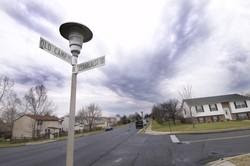
Old Camp Road on the former site of Camp Frederick.
Read more here. 
The Geneva Convention also declared that POWs must receive the same quality of diet as the captor’s soldiers. The diet in a Maryland POW camp consisted of an average of 3,500 calories a day and included rolled oats, milk, raised bread, and coffee for breakfast, and vegetables, bread, fruit, and water for lunch. Dinner might be soup, vegetables, salad, bread, and tea. Typical activities that the prisoners were permitted to participate in were athletic, cultural, educational, and religious. Some camps even formed small orchestras. POWs at Camp Frederick even leveled a field on which to play soccer.

Prisoners were generally well treated and well behaved. In at least one instance at Frederick, a guard who had recently returned from service in Germany beat some prisoners severely with the butt of his rifle after the prisoners teased him. Former camp guard Charles P. Wales, on other hand, attested, “I never heard of any time when a gun was even pointed at a prisoner at the camp.” He explained that by the time he got to be a guard at the camp, the war was over and most of the men did not want to fight, but simply wanted to go home. In addition, there were 400 prisoners among 45 American guards who had received little training in handling the prisoners and could easily have been overtaken.

Some of the prisoners—especially Nazi sympathizers—became violent towards other prisoners or tried to escape. Most prisoners who managed to duck out of the camp guards’ sight and run off were recaptured within 24 hours. An article appeared in the Frederick News-Post on January 4, 1945, concerning the notification of the public in the event of a prisoner’s escape, in which the mayor declared that he was “100 percent in accord with the suggestion that the community be promptly informed of any such escape.”

Some daring escapes did occur in Maryland. Two prisoners at Camp Frederick who had managed to secure unmarked clothes cut through the fence and walked backward away from the camp, eventually catching the bus at Braddock Heights. The driver was suspicious and called the police, and the two POWs were captured in Hagerstown. One of them was Peter Siegfried Muetzel, who preferred to escape to Cincinnati rather than go home to the Russian sector of Germany where his home had been destroyed.

The most dramatic escape occurred when the 21-year-old, English-speaking Hermann Pospiech eluded the FBI for five months after walking out of Camp Somerset in southern Maryland. He managed to get all the way to New York City, where he was found with a Social Security Card in his name and a U.S. Army discharge pin.

Strikes were also rare and mostly happened when the prisoners found their work to be too difficult or demanding—some protested because they felt their work was too closely related to the war effort, and therefore, in violation of the Geneva Convention. Others did not want to lift or remove objects that were too heavy, protesting tasks such as clearing out large trees in the winter. To deal with this problem, the “No Work, No Eat” policy of World War I was adopted by the provost marshal’s office, restricting an uncooperative prisoner’s diet to bread and water.

A 1944 article from a Maryland newspaper entitled “War Prisoners Wouldn’t Work: Those Here Put On Bread, Water Diet” describes this punishment being inflicted upon prisoners in “a camp near Frederick, Md.,” for protesting and refusing to work. Apparently, the tactic worked as leaders of the camp received “a promise to work [the next] day.”

Due to the success of the first two stages of the POW program, in 1944 the War Department developed a new project as part of its third and final phase of development: changing the political views of the prisoners from National Socialism to political democracy. The project was called the Prisoner of War Special Projects Division (POWSPD) and especially took off in 1945 after it was clear that the Third Reich was destined to fall. Since the Geneva Code did not allow the POWSPD to force its ideas upon the prisoners, the program was voluntary, and was euphemistically entitled “Intellectual Diversion.”

It should be stated that many of the prisoners did not support Adolph Hitler or the fascist regime in Germany, and only an estimated eight to ten percent of the total German POW population were known to be adamant Nazi sympathizers. Some of the more militant Nazis were known to harass less committed soldiers. Others burned copies of Der Ruf (The Call), an anti-Nazi newspaper written by German POWs across the United States and overseen by the POWSPD. It was based in Rhode Island at the German POW camp, Camp Kearney.

Those prisoners who refused to integrate into regular camp life were placed in segregated camps with each other, one of which was in Oklahoma. The POWSPD program chose to focus more instead on anti-Nazis and political moderates, “stimulating individualism among them and eroding uncritical habits.” One method used to help transform the prisoners psychologically was to show them graphic images, such as piles of naked, starved corpses, or to hang up posters with these images throughout the camp. Der Ruf also included haunting images and detailed information about the concentration camps in Europe.

One major part of the political indoctrination of the prisoners was the POWSPD’s dispatch of Assistant Executive Officers (AEOs) to the campsites to discuss and compare the histories of the United States and Germany. These AEOs attempted to convince prisoners that the German past had been riddled with failures due to their governments, while the American commitment to democracy had helped it develop so successfully. They hoped to instill in the prisoners the idea that democracy was the best option for rebuilding Germany after the war.

POWs at Camp Frederick

Above is a general overview of the camp life and activities that many German POWs in Maryland experienced. Now Camp Frederick itself will be specifically discussed, with information both supporting and adding to that which was previously presented.

In the fall of 1944, the September 4 issue of The Post announced in a brief article that the former Civilian Conservation Corps camp, which was built in 1933 and located just west of Frederick, would soon become home to about 350 German POWs. This was followed by another small article shortly after, which informed citizens that 30 POWs were already on-site preparing tents for the camp, and it would open within two weeks under the command of Captain Eugene Messner. A large crowd reportedly gathered to watch the prisoners arrive by train and be ushered onto buses that headed to Camp Frederick, located off old Route 40.

The men, whose average ages ranged from 17 to 45, were mostly privates and non-commissioned officers from the Afrika Corps. Many had been initially captured by the British troops, but Britain—dependent at the time upon imports—was unable to feed or support its POW population, and so many ships carrying supplies or troops from England to the U.S. delivered prisoners as well. They would be staying in large six-man tents on the four-acre plot of land that had formerly belonged to the Klein Farm and is today a residential neighborhood on the fringes of the supermarket, gas station, and restaurant filled west end of the “Golden Mile” on Route 40.

The public was told in an article in The Post in 1979, entitled “What’s in the Name? Old Camp Road,” that the average stay of the men would be anywhere from two weeks to over a month, and the camp was cleverly termed a “detainment center used to hold captured soldiers until the necessary papers could be processed for their return home.”

Also, according to the article, the men’s daily activities consisted of being transported from the camp at 7 a.m. to a nearby farm and being picked up again around 5 p.m. A single guard might watch over five to ten prisoners while they worked. Former camp guard Charles P. Wales explained that “when only a few prisoners were sent out for work there was usually no guard sent along with them. Larger groups were sent with a guard.”

There is some evidence that suggests that the seemingly low-key publicity surrounding the coming of the POWs continued throughout its existence until well after the war was over. According to “What’s in the Name? Old Camp Road,” the camp had maintained a low profile throughout its operation and “some senior citizens [could not] recall its existence. The only Fredericktonians to come in direct contact with the camp or its detainees were a handful of civilian drivers and a dozen or so farmers.” This may be exaggerated, as many of the family members and friends of farmers who hired the POWs encountered them on a regular basis.

At any rate, in 1967, a little more than 20 years after the war ended, a sudden surge of interest in the German POWs hit Frederick after an article in The News on February 15, 1967, spoke of a “frantic search for the location of any German prisoner of war camp” in Frederick. The article, entitled “Where, Oh Where, Was That German POW Camp?” was in response to a letter the paper received in 1949 from a former POW, Peter Siegfried Muetzel. The letter, recovered 20 years after Muetzel’s escape from Camp Frederick and recapture in Hagerstown, expressed Muetzel’s gratitude to the people of Frederick, who he explained were “extremely kind to him.” According to the article, several historians were also questioned about the camp, and “several people said there were several camps in the area,” but oddly, they did not know or remember the location of the camp.

The next day, the newspaper printed an article called “County Residents Recall Camp For POWs Here,” about how several residents actually did remember the camp and its inhabitants, including Cyril Klein, whose father had owned the land that the camp was located on. Another article was printed the same day, called “‘Lost Prisoner Camp Was Located Near City,” and claimed that because of “nearly 100 phone calls from interested citizens,” the location of the camp could finally be identified as off old Route 40 near the Klein Farm. Clearly many citizens remembered Camp Frederick after all.

The day after that, February 17, The Post ran an article with photos in response to inquiries about the “now dismantled camp,” called “POW Camp Revisited 20 Years Later.” Author Nelson Brooks actually ventured out to the location of the former camp and discovered an empty pasture with a series of “concrete floors minus any walls or shelter facilities.” He also noted inlaid brick walkways, old rusty nails lying in the grass, latrines with household items tossed into them, and old shoes. The most interesting artifact he found was a six-foot semicircle carved into the concrete depicting a man swinging an axe at one end, and a man with a pick on the other, both with a ball chained to their legs. He found no sign of a 600-foot deep well rumored to have been used on the property, but did locate a dam across the creek between the camp and the highway, with a large metal pipe that once carried water from the stream to a nearby pond.

The next day a new article, “POW Camp Near City Part of Fort Meade,” was published, which announced that the paper had gotten in touch with Pentagon spokesman Charles Romanus, of the Reference Branch of the Military History Department at the Pentagon. Romanus confirmed the already obvious existence of Camp Frederick and asserted that 336 prisoners alone were sent there in 1946.

Why, 20 years later and not sooner, was such interest in the POWs rekindled? It seems that in spite of many citizens’ general lack of knowledge of the camps, there were many people who did come in contact with the POWs and who had not forgotten about them. As stated before, many more civilians than anticipated had observed, worked with, or were host to the prisoners.

"Stories from Camp Frederick: German World War II POWs in Frederick, Maryland," copyright 2023 Amelia Cotter (variations of this article series first appeared in Frederick Magazine and German Pulse in 2012, and in German-American Journal in 2009)

Friday, October 20, 2023

Stories from Camp Frederick: German World War II POWs in Frederick, Maryland, Part 3

October is German-American Heritage Month and one of the topics I'm contacted about frequently is the history of German World War II POW camps in Maryland. I studied German and History at Hood College in Frederick, Maryland, where I researched and have subsequently written several articles and papers on this topic. I'm sharing this article series over the course of four weeks, continuing this week with "Personal Accounts and Memories" and "One Soldier's Story: Erich Pahlow," and next week with the "Conclusion" and "Bibliography." Variations of this article series have appeared in Frederick Magazine, German-American Journal, and on the German Pulse website. I look forward to resharing it now, with revisions, and keeping this dialogue, research, and these stories alive:

Personal Accounts and Memories

Several personal letters, interviews, and articles survive which give various insights into what it must have been like to be a German POW in Frederick, or what it was like to encounter or work with one. These experiences represent a broad array of perspectives, from the POWs themselves to the residents of Frederick who found them to be nice young men and good workers, or a threatening menace to their community.

According to Judge Robert Clapp, Jr., a soldier during the war who had kept up with local events, “people in general were very receptive to the idea of the German prisoners being here.” Catherine Handley, wife of a foreman at the Stoner and Powell lime plant at Fountain Rock on Biggs Ford Road, stated, “People were a little intimidated about the prisoners coming here, but we really needed manpower to have that lime when farmers came for it, or to load on the train. But we found they were just people. They were good workers, and after a while there was no apprehension.”

“They were big, blond German boys. Too bad we didn’t take any pictures,” said Middletown resident Betty Powell, who grew up on a farm where the prisoners had worked.

POWs were transported to and from the fields by farmers, as in this photo
of prisoners at Fort Meade. Photo courtesy of The Baltimore Sun.
Cyril Klein said they “had a well 600 feet deep and they still didn’t have enough water.” He also remarked that the men were happy to have been “captured by the Americans, rather than by the Russians…They were deathly afraid of the Russians. They were also deathly afraid of airplanes. Every time a plane would go over, they would all stop what they were doing and watch it.”

Dr. Howard Ash spoke of a sick call every day at 4 p.m. Dr. Ash said prisoners were only to get a few sandwiches a day, but farmers felt sorry for them and gave them a “good country meal.” He also stated that one of the prisoners found work in Silver Spring at a surgical instrument factory after his time as a POW had ended. Woodrow Hanley of Walkersville claimed to have written back and forth with several of them for years since the war ended.

Wilson Stull recalled a time when he accompanied a driver, his friend John J. Keilholtz, to pick up the prisoners at the end of a workday. He said that they had been working that day with no guard, and at that on the way home, Keilholtz stopped at a liquor store, bought a fifth of whiskey, and “about 50 yards from the main gate of the camp, he pulled over behind some bushes and the seven of [them] killed that bottle of booze.” Stull had talked to a 19-year-old prisoner who spoke English, and who told him that he was “forced to join the German army under penalty of death.”

Carroll James, a Hagerstown resident, recalled stopping by a farm east of Thurmont, where he spotted POWs working with no guard in sight.

Harold Stull (no relation to Wilson) received ten POWs on his farm between October and November 1944 to help him and his wife shuck corn. He also recalls a navy man there named Hans von Reiter who had attended Oxford and spoke perfect English. On the days that Reiter worked, there was no guard. “The army had entrusted the work party to him.” Reiter’s aunt lived in Silver Spring and had always sent him new clothes. Stull remembered one American soldier who had returned from the war and was placed as a guard. “I guess the visions of his friends being killed by the Germans was crystal clear in his mind because on the first day, a couple of the prisoners gave him a bit of trouble and he beat the hell out of them with the butt of his rifle.”

Harold Stull also recalled that some of the soldiers were in their forties and were pulled from the farms to be put into the army. Others were college professors who “knew more about Frederick County history than most residents.”

A collection of letters to and from Richard Lebherz, an American soldier and resident of Frederick County who was deployed to France and Germany in World War II, gives some further insights into the sentiments surrounding the German POWs. In a letter to Richard from Mrs. B.O. Thomas, Sr., a friend of the family, dated September 26, 1944, she described the activities of the POWs: “German Prisoners are in the old CCC Camp across the road. They have been digging a ditch across to the old well for their water. They laugh and play with Billy. Billy carries a wooden gun and imitates the armed guard with them. At rest periods they carry Billy around and pass him from one to the other to hold. It does not seem possible that these same men are capable of the horrible crimes they have committed in enemy country.”

Later, on November 9, 1944, Thomas wrote another letter to Lebherz mentioning the POWS, this time in a more negative light. The letter does not state why she changed her mind about her feelings towards them, but the passage concerning the POWs comes directly after a paragraph about a memorial service to be held for the Frederick soldiers who had died in the war. She wrote, “I have no illusions about the Prisoners here. I wish we did not have to look at them ever. I feel sure they are Nazi Youth as some of them are very young. It will take us older people a long time to overcome our distrust, —if we ever do. More and more I know the difficulty of the command ‘Love Thy Neighbor as Thyself.’”

Lebherz’s aunt Mayetta Hershberger, an executive of the U.S. Employment Service, sent a letter to Richard on October 4, 1944, also discussing the prisoners briefly: “We have now three hundred German prisoners of war here and my office is responsible for seeing that they are put to work. They are stationed at the old C.C. Camp across from the Catoctin Country Club. They certainly are a sad looking lot and so very young.”

On November 19, 1944, Patsy Heffelfinger, believed to be the Chief of Civilian Personnel at Camp Detrick, wrote to Richard: “In case you haven’t come face to face with any living Nazis this is to inform you that we have them working at the depot and whenever they are injured an MP brings them to me and I either do the honors or send them to their Dr. I’ve been both smiled at and Heil’d! Frankly, if every one of them accidently [sic] slit their throats I’d inwardly feel a sense of relief.”

In a letter from Lebherz, who was in France at the time, to his parents on December 11, 1944, he responded to the news of a German POW camp being in Frederick with disgust: “Aunt Mayetta wrote me that there are three hundred German Prisoners across from The Club, and I can imagine now Frederick must be perplexed as to how they should be treated. I hope not kindly at any rate. How ridiculous life can make things. There they are in Frederick hoping to get back to Germany, and here I am dreaming of getting back to Frederick. Now, does that make sense. Nevertheless, don’t let yourselves be fooled by them with their look of innocences [sic], as many of the ones you will see, probably have killed many American soldiers with no feeling except fanaticism and cold emotional tactics. Don’t be fooled! That is the most important thing at the present moment. We must not allow Germany to fool us once again.”

Richard’s mother, Mary Lebherz, wrote to him on March 19, 1945, “Yesterday we went up to the German prison camp, and it just burned me up, to see how well they are treated over here, and to know how they treat our boys over there.”

On February 11, 2004, a very sentimental letter was sent to the Frederick News-Post in response to an article entitled “The Golden Mile: Then and now,” which was published February 1 and had mentioned Camp Frederick. Dolly M. Burdette of Bunker Hill, West Virginia recalled that when she and her husband were newlyweds, her husband had worked as head dairyman on a farm in Ceresville and had driven the POWs to and from work. He “would pick up about 10 POWs, and they climbed in the back of the farm truck, with one guard. I remember the prisoners as being young, handsome, polite, and hard workers.” She also stated that after the war ended, some of the prisoners said they “did not want to go home. They would rather stay here because this is the greatest country in the world.” She then thanked the paper for bringing back those happy memories.

One Soldier’s Story: Erich Pahlow

POW and native Berliner Erich Pahlow is one example of a prisoner who managed to build a lifelong relationship with some of the people he met while serving in Frederick. He corresponded regularly with Charles Thomas and returned to Frederick in 1980 to visit Charles’ mother, Mrs. George Leicester Thomas, at the Buckeystown farm where Pahlow had worked. Pahlow spoke in his own words about his experience as a POW in a number of articles printed by the Frederick News-Post and Frederick Magazine.

Before the war began, Pahlow lived in Berlin with his wife and three children and worked as a commercial artist. “I had a lot of American friends and personally had no reason to be against the U.S. But when political powers go to war, the rest of us are forced to follow.”

He was drafted in 1940 at the age of 30 and was captured in 1943 in Lyon, France by a young American lieutenant. “All he did was grab my gun and throw it to the ground. The American just asked me where I lived and then proceeded to tell me that he had studied in Heidelberg.” Pahlow continued by adding, “I never even had to use that gun. People don’t realize how much listless sitting and waiting there is on the battlefield. The only way to keep sane is to stay occupied, so I drew a lot and painted.”

He, along with other prisoners, were taken to Oran, Tunisia and then arrived in Norfolk, Virginia after a 16-day trip on an aircraft carrier. “The crossing was the hardest part of the war for me. Each moment took me farther from home to some unknown place…I couldn’t even tell [my wife] that I was alive.”

After picking apples in Winchester, Virginia for one season, he was transported to Frederick, where he cleared land on farms. He also had to clear the border of a lake by removing trees and debris where a dam for a Washington, D.C. reservoir would be constructed. He explained, “This was a hard job for an artist, felling trees with a saw and an ax from eight ’til four every day.” He recalled going to Ft. Eustis on occasion to hear lectures about American life and democracy and receiving lessons in English. He also remembered “a number of musicians among the P.O.W.s, who created a band with instruments donated to them by local churches and Frederick residents. They performed for the American G.I.s and officers each Saturday.”

Pahlow’s greatest relief was to be able to continue painting. “I kept up my artwork and was soon asked to do signs and portraits for both Americans and Germans around Frederick County. The camp provided me with supplies and even a studio facing the north—the direction I suggested for the best light.” He even painted a Dutch scene on the kitchen wall of the Thomas’s house.

He was released in 1945 and said that his reunion with his wife was the greatest moment of their lives, even though they could not return to Berlin. “It was impossible… All of our friends and possessions were gone, and the only inhabitants left in the city were Russian and American police. It was like a cage.” Pahlow soon received a letter of recommendation from the commanding officer at the prison camp and got a job with an advertising agency. The Thomas’s helped to support him and his family by sending clothing, food, and books.

Though Pahlow had fond memories of the farm, Charles Thomas, who was ten years old when Pahlow and the prisoners came to work for his father, recalled Camp Frederick being nicknamed the “Frederick Hilton,” and remembered making a family trip to the camp to see a Christmas play the POWs put on in December 1945.

He poignantly summed up how difficult it was for the prisoners and citizens of Frederick to get used to living with each other: “When the Germans first came, Americans were cold to them and feared them. Some of the first farmers to use prisoners were even ostracized by the community. As time went on, however, those fears vanished, and many people became quite close to the prisoners.”

"Stories from Camp Frederick: German World War II POWs in Frederick, Maryland," copyright 2023 Amelia Cotter (variations of this article series first appeared in Frederick Magazine and German Pulse in 2012, and in German-American Journal in 2009)

Wednesday, May 6, 2026

More Stories from Camp Frederick: The Art of Erich Pahlow

In September, I was interviewed in Frederick Magazine ("Talking History with Amelia Cotter") about German World War II POWs in Maryland, a subject I've written about on and off for the last two decades ("Stories from Camp Frederick: German World War II POWs in Frederick, Maryland"). Once in a while, I get an email or contact form with stories, questions, and other insights into prison camps, POWs, and internment camps across U.S. history.

Some of the collection of 18 original paintings
by Erich and Johanna Pahlow.
This winter, I was contacted by an artist and art collector from England, Kev, who was interested in my research on one German POW, Erich Pahlow, a commercial artist from Berlin. Pahlow was conscripted in 1940 at the age of 30 and left his wife Johanna, also a painter, and their three children behind in war-torn Berlin. He was captured in 1943 in Lyon, France, and then sent to Camp Frederick in Frederick, Maryland. Upon his release in 1945, he was reunited with his family, and he and Johanna spent the better part of their lives painting and exploring the world together. Pahlow was born in Berlin in 1911 and died in Bad Nauheim in 2006. Johanna passed away in 2012.

Pahlow's story is one of the most well-known among the German POWs. Like many POWs in the United States, he was sent to work at a local farm in Buckeystown. There he formed a lifelong bond with the Thomas family, even painting a mural on their kitchen wall. Pahlow corresponded regularly with Charles Thomas, who was only ten years old when they met, and returned to Frederick in 1980 to visit the family and farm again. Pahlow spoke about his experience as a German POW in articles printed by the Frederick News-Post and Frederick Magazine.

More of the collection of 18 original paintings
by Erich and Johanna Pahlow.
Kev reached out to me because, in his travels as an artist and art collector, he had acquired 15 original paintings by Pahlow and three by Johanna. We formed a friendship over the course of a few months, emailing back and forth about Pahlow as well as our own personal lives and experiences. Kev offered to email me photos of the paintings and even send me some prints of them. He went so far as mentioning leaving the collection to me one day, which seemed unfathomable. What an honor. We talked it over and after some thought, Kev came back and said he was just going to send me the entire collection now. So, this April, I received a large package from England with all 18 original paintings.

The paintings include linocut, watercolor, and other media. The oldest painting in the collection is a watercolor Pahlow painted in 1941 on the Dniester River in modern Ukraine (bottom photo, far right). This would have been just prior to Operation Barbarossa, the German invasion of the Soviet Union. Kev joked, "It appears that Erich was much more interested in painting than invasion."

The rest of the collection of 18 original paintings
by Erich and Johanna Pahlow.
Pahlow himself said, "I never had to use [my] gun. People don't realize how much listless sitting and waiting there is on the battlefield. The only way to keep sane is to stay occupied, so I drew a lot and painted." As we observe the global resurgence of fascism and witness it taking hold around us, it becomes easier to understand that Pahlow, like many Germans, was in no way a Nazi sympathizer. Pahlow said, "I had a lot of American friends and personally had no reason to be against the U.S. But when political powers go to war, the rest of us are forced to follow."

Receiving this collection of paintings was, in a word, overwhelming. Holding each one of them in my hands bordered on surreal. I am so grateful to be the steward of these paintings, with special thanks, of course, to Kev for being so gracious and supportive, and trusting me and Jonathan with this beautiful collection.

Jonathan and I are planning to frame at least one by Pahlow and one by Johanna, with further plans to display them all in the future. What an interesting journey I've had over the years with this strange and often dark piece of world history. But what a beautiful footnote, or perhaps prelude, to a decades-long relationship with the life story of this remarkable POW. Read more about Erich Pahlow here.