Showing posts with label Guest Posts. Show all posts

Monday, May 15, 2023

Guest Post: Photography, by Jonathan Montgomery Pollock

Note from Amelia: Jonathan and I have been married for lucky seven years this month (May 8!) and I asked him to be my guest writer. Jonathan is a man of many talents: musical, photographic, and he's the alchemist behind the divine scents and sensations at Amelia's DragonGoddess Boutique. Here he shares a little more about his creative process as a photographer. Jonathan's beautiful photography can be experienced through our Pathways Notecards (Set of Five), with some of the featured images from that collection shared below. Currently, his music can be experienced at the Peggy Notebaert Nature Museum's My Journey into the Wilds of Chicago exhibit:

Electric glow buds in Chicago, Illinois.
Photo by Jonathan Montgomery Pollock.
While scrolling through thousands of thumbnails in order to pick a few of my favorite photographs to share on Amelia's blog, I tried to pick ones I could write something about. I recently helped build an immersive projected art installation at the Peggy Notebaert Nature Museum that features the nature photography of Mike MacDonald. In addition to being a brilliant photographer, he is also great at talking about his work. His presentations are poetic narratives that extol the majesty of urban nature, and I bet he can tell you the story behind every one of his photographs. When I finally picked a few to share, I struggled to verbalize reasons why they are particularly meaningful to me. I will instead try to articulate my creative process.

For me, photography is very Zen. I'm usually "zoned out" and operating in the periphery of my conscious awareness, working intuitively, and shooting almost indiscriminately. Setting the shutter speed, lens aperture, and ISO are conscious and volitional acts, but once I make those technical choices, I commit to them and don't think about working the camera again.

Prairie path near Horseshoe Mound Preserve in Galena, Illinois.
Photo by Jonathan Montgomery Pollock.
When I start shooting, I quickly become aware of the rhythm of my breathing. I don't use a tripod, and I use a wide-angle lens that doesn't let much light in, so I need to be very still. I usually press the shutter button right between inhaling and exhaling, taking a single shot at every interval. Once that rhythm is set, most of the actual compositional work is done by my subconscious. Form, lighting, color, rhythm, texture, depth, contrast, and space are being assessed below the level of my conscious awareness. When the shoot is over, I go through the entire batch one time fairly quickly, jotting down the file names of only the photos that induce an immediate emotional response. Usually, I end up with between two and ten keepers after a full day of shooting. Since I'm only partially "there" while shooting, I get to feel like an observer when I look at my own work, which is pretty cool.

I take my best photos when Amelia and I are on our adventures, visiting cool places. That's a big part of my formula for success: if you go to interesting places, you'll end up with interesting photos. The other part is to just start shooting—and keep on shooting!

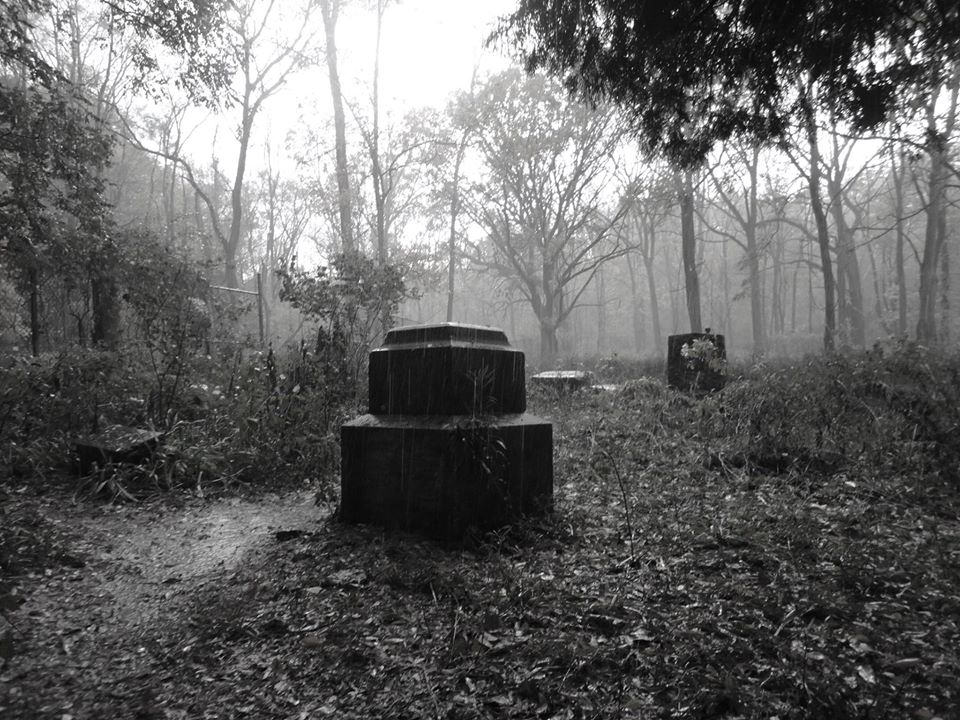
Haunted Willow Creek Farm in Shannon, Illinois.
Photo by Jonathan Montgomery Pollock.

Jonathan Montgomery Pollock is an independent recording engineer, photographer, guitarist, botanical perfumer, and museum exhibits specialist based in Chicago. He is, of course, also my partner in life and crime.

"Photography" (essay and photos), copyright 2023 Jonathan Montgomery Pollock

Monday, October 17, 2022

Guest Post: The End of Something, by Louise Masino-Cotter

Fall Poetry Series: This is my 100th blog post! And to celebrate, I'm letting my mom do all of the work. Part of the apparitions project involved sharing poetry and photography from other talented writers and artists, in celebration of the book's publication and this incredible year of poetry. I promised another short poetry series this fall, which encompasses the poems I've shared in my non-poetry books, including This House: The True Story of a Girl and a Ghost, Maryland Ghosts: Paranormal Encounters in the Free State, and Where the Party Never Ended: Ghosts of the Old Baraboo Inn. Alas, Breakfast with Bigfoot lacks a dedicated poem, but makes up for it in poop jokes. This week, we'll take it all the way back to This House again, which features the beautiful poem, "The End of Something," written in 1981 by my mom, Louise Masino-Cotter:

It is not there, do you hear it?
The pulse does not die at the sound of it.

The heart does not crush at the weight of it.
Hands have quieted over the table top.

They are still and pleased with having nothing to do.
It is this end that they have prayed for.

Winter has shut itself off so suddenly; so has love.
Even the sun shows no mercy today.

"The End of Something," copyright 2022 Louise-Masino Cotter (previously published in This House: The True Story of a Girl and a Ghost)

Monday, June 6, 2022

Guest Post: Selected Photography, by Karl K, Wendy Moxley Roe, and John B. Stephens

Note from Amelia: An early part of the apparitions project involved collecting the poetry and photography of other talented writers and artists to share as part of a greater anthology. This component of the project didn't quite come together for many reasons, but I wanted to share the finest work Jonathan and I received as part of our celebration of the book's publication and this incredible year of poetry. I've shared this spring and summer series alphabetically by last name, concluding with the beautiful and haunting photography of friends and fellow Fortean enthusiasts Karl K, Wendy Moxley Roe, and John B. Stephens. Their portraits below highlight some of Chicago's most haunted places, including Bachelor's Grove Cemetery, Graceland Cemetery, and the Congress Plaza Hotel. I'm grateful to all contributors for sharing their wonderful work and look forward to highlighting more creators in the future, with another short poetry series coming this fall:

Bachelors Grove Cemetery in Midlothian, Illinois.
Photo by Karl K.

Graceland Cemetery in Chicago, Illinois.
Photo by Wendy Moxley Rowe.

Congress Plaza Hotel in Chicago, Illinois.
Photo by John B. Stephens.

"Bachelors Grove Cemetery," copyright 2022 Karl K; "Graceland Cemetery," copyright 2022 Wendy Moxley Rowe; and "Congress Plaza Hotel," copyright 2022 John B. Stephens

Monday, May 30, 2022

Guest Post: Ghosts in the Machine, by Jenene Ravesloot

Note from Amelia: An early part of the apparitions project involved collecting the poetry and photography of other talented writers and artists to share as part of a greater anthology. This component of the project didn't quite come together for many reasons, but I wanted to share the finest work Jonathan and I received as part of our celebration of the book's publication and this incredible year of poetry. I'm sharing this spring and summer series alphabetically by last name. Today's layered, personal haibun, "Ghosts in the Machine," was written by Chicago poet Jenene Ravesloot, one my poetry collaborators and mentors:

Ghosts in the Machine

12/01/2016 PROCEDURE: CT Chest WO Contrast.
LUNGS/CENTRAL AIRWAYS: There is a 1.1 cm right upper lobe spiculated nodule corresponding to the abnormal chest x-ray. There are small satellite nodules adjacent to it.
CONCLUSIONS: 1.1 cm right upper lobe nodule with adjacent satellite lesions. Differential diagnosis includes lung cancer or an active granulomatous process. Recommend a PET scan.

breathing in and out
breathing in and out and in
practicing Zen breath

12/23/2016 PROCEDURE: PET/CT Skull to Thigh.
IMPRESSION: The F-18 FDG PET/CT study demonstrates metabolic activity in the 1cm right upper lobe pulmonary nodule, which is indeterminate for malignancy. If there is a strong clinical suspicion that this could represent an early malignancy, tissue sampling is suggested. Alternatively, follow-up PET/CT imaging in 6 months to one year is suggested to assess for any change in size or metabolic activity. There is no abnormal metabolic activity identified elsewhere in the chest, abdomen, or pelvis.

a small gift from you
a glass globe of swirling snow
many emotions

6/1/2017 PROCEDURE: CT Chest WO Contrast.
CONCLUSIONS: A 15 mm right upper lobe ground-glass nodule is stable from 12/1/2016. Given the size and morphology, this likely represents low-grade lung cancer. Multiple additional ground-glass and solid nodules measuring up to 4 mm are stable.

unable to sleep
the sound of a car alarm
this watchful waiting

11/27/2017 CT Chest WO Contrast.
CONCLUSIONS: A right upper lobe sub-solid nodule measures 18mm compared to 17 mm on 12/1/2016. Given the morphology, this is suspicious for low-grade lung cancer. The differential includes focal fibrosis. Multiple additional ground-glass and solid nodules measuring up to 4 mm are stable.

the final report
surgery recommended
lung cancer likely

"Ghosts in the Machine," copyright 2022 Jenene Ravesloot

Monday, May 23, 2022

Guest Post: Selected Poems, by Louise Masino-Cotter

Note from Amelia: An early part of the apparitions project involved collecting the poetry and photography of other talented writers and artists to share as part of a greater anthology. This component of the project didn't quite come together for many reasons, but I wanted to share the finest work Jonathan and I received as part of our celebration of the book's publication and this incredible year of poetry. I'm sharing this spring and summer series alphabetically by last name. Today's achingly poignant poems, "Ghosts" and "Her Song," were written by my mom, Louise Masino-Cotter. I think you'll see where I get my knack for poetry. "Her Song" is one of the best poems I've ever read. My cousin Chris, named for our Uncle Chris, even has a tattoo of it. I believe that once you read it, you'll agree it's a masterpiece, too:

Ghosts

(for Amelia)

The wounds of the past will not heal over.
Instead they are forever surfacing, haunting me.
There is no relief from the pain. Nothing can
Free me from my sorrow.

I have always disliked afternoons, the long, wretched
Stretch of day after morning has ended and night is
Yet to come. I associate afternoons with loneliness
And loss, pain and a longing for something I cannot
Put my finger on. I do not like afternoons for the
Same reason I cannot, at times, stand living within
My own skin. I am unable to free myself from either.
Should I ever take my life, it will be in the afternoon.

--

Her Song

(Written January 22, 1993, for Chris, who died March 11, 1991.)

There was a voice so sweet, it called to me
A voice so pure and light
It awakened me from my turmoil
And drew me to the night

Reassuringly, it told me, why
Soon you will be free
Just a moment of pain, now come along
And we’ll walk to the tree

There was a voice so sweet, it sang to me
And promised my soul to keep
It soothed and lulled and rocked me
In its arms I wanted sleep

Like a mother the voice did cradle me
And shushed me not to cry
From the rope I knelt and settled and
In her arms there I did die

"Ghosts," and "Her Song," copyright 2022 Louise-Masino Cotter ("Her Song" previously published in Way of the Word Limited First Edition Anthology, 2009)

Monday, May 16, 2022

Guest Post: Selected Poems, by Candice Lola

Note from Amelia: An early part of the apparitions project involved collecting the poetry and photography of other talented writers and artists to share as part of a greater anthology. This component of the project didn't quite come together for many reasons, but I wanted to share the finest work Jonathan and I received as part of our celebration of the book's publication and this incredible year of poetry. I'm sharing this spring and summer series alphabetically by last name. Today's masterfully rendered poems, "It's All Politics" and "Labor Vampire," come to us from longtime friend, former colleague, and writer, storyteller, and essayist Candice Lola:

It’s All Politics 

Why do you have to be so political all the time, Candice?

Because when I cut my hair I was told I was trying to be radical
When I straightened my hair I was ridiculed
When I ignored being excluded I was told I wasn’t good enough
When I made space for myself I was told I was conceited
When I was getting beaten I was told that I deserved it
When I spoke up for myself I was told that I was a bully
When I didn’t correct you, you told every Black person you met afterwards that I endorsed your casual racism
When I did correct you, I was “unnecessarily making it about race”
When I participated in mainstream culture I was called a lesser version of it
When I participated in my own I was called ghetto
When I assimilate I'm a second class citizen
And when I don’t, I’m unAmerican.
You see?
Someone else dissected my life and told me I was wrong before I got here.
So I have no choice in this existence.
While in this skin
and under this hair
and behind these lips
and in front of our past
my very breath is politics.

--

Labor Vampire

There isn’t much left to you
he chuckled as he
carved off pieces of my legs
and then mocked me for limping.

"It's All Politics" and "Labor Vampire," copyright 2022 Candice Lola

Monday, May 9, 2022

Guest Post: knowing eyes, by Ann Lamas

Note from Amelia: An early part of the apparitions project involved collecting the poetry and photography of other talented writers and artists to share as part of a greater anthology. This component of the project didn't quite come together for many reasons, but I wanted to share the finest work Jonathan and I received as part of our celebration of the book's publication and this incredible year of poetry. I'm sharing this spring and summer series alphabetically by last name. Today's poem, "knowing eyes," was written for me by my dear friend and fellow haiku poet, Ann Lamas:

knowing eyes
when daisies and oncologists
were mentioned

"knowing eyes," copyright 2022 Ann Lamas

Monday, May 2, 2022

Guest Post: Embers, by Richard Hartley

Note from Amelia: An early part of the apparitions project involved collecting the poetry and photography of other talented writers and artists to share as part of a greater anthology. This component of the project didn't quite come together for many reasons, but I wanted to share the finest work Jonathan and I received as part of our celebration of the book's publication and this incredible year of poetry. I'm sharing this spring and summer series alphabetically by last name. Today's deeply thought-provoking poem, "Embers," comes to us from UK poet Richard Hartley:

Was there really any point to it all?
What useful purpose have I served
While living out my bleak and lonely life?

Searching for answers, many men
Gaze into the dying embers of a fire
And measure their life’s worth therein.
So too have I been gazing –
Into the dying embers of my life
And taking the measure of my worth.

There will be no statue to celebrate my life.
No awards to mark some great achievement.
No learnèd books to argue and explain
A great contribution made to help mankind.

Like an early evening shadow, dancing
Across the choppy waters of the bay,
I too have crept silently through life
Un-noticed, un-seen and un-remarked.

And just as that shadow will vanish
Un-remembered with the setting sun,
So too will my life fade from view
And leave no passing mark upon the earth.

"Embers," copyright 2022 Richard Hartley (previously published in An Early Spring Day, 2019)

Monday, April 25, 2022

Guest Post: Selected Poems, by Tim Gardiner

Note from Amelia: An early part of the apparitions project involved collecting the poetry and photography of other talented writers and artists to share as part of a greater anthology. This component of the project didn't quite come together for many reasons, but I wanted to share the finest work Jonathan and I received as part of our celebration of the book's publication and this incredible year of poetry. I'm sharing this spring and summer series alphabetically by last name. Today's beautiful poems, "a tsunami" (tanka), "Hangman's Hill" (haibun), and "wind chimes" (haiku), come to us from longtime friend and fellow poet Tim Gardiner:

a tsunami
warning sign
on the shore...
            what happens to those
            who cannot run away

--

Hangman’s Hill

I drop the handbrake and wait. Slowly my car begins to roll uphill towards the hanging tree. So the legend is true; the hangman’s ghost is dragging me to eternity. I glance at the rope on the rear seat, moonlight glinting off its grain, throwing out a surfeit of shadows. Reaching the hanging tree, bent double and alone on the hillside, I pull on the brake. On closer inspection, the distant lights of city skyscrapers don’t seem to touch the bark of this isolated hawthorn. My last thought is of a small boy, cocooned in childhood, playing cricket on the beach until the evening comes.

just an illusion
the hill’s dark secret

--

wind chimes...
someone else’s tragedy
hangs from a yew

Dr. Tim Gardiner is an ecologist, editor, essayist, poet, and children’s author from Manningtree in Essex, UK. He has been widely published in journals and anthologies. He is a former co-editor of the tanka prose section of  Haibun Today and now edits a poetry column for the punk fanzine  Suspect Device.

"a tsunami," "Hangman's Hill," and "wind chimes," copyright 2022 Tim Gardiner

Sunday, April 17, 2022

Guest Post: walking, by Charlotte Digregorio

Note from Amelia: Today is International Haiku Poetry Day! An early part of the apparitions project involved collecting the poetry and photography of other talented writers and artists to share as part of a greater anthology. This component of the project didn't quite come together for many reasons, but I wanted to share the finest work Jonathan and I received as part of our celebration of the book's publication and this incredible year of poetry. I'm sharing this spring and summer series alphabetically by last name. Today is a fitting day to share "walking," by Charlotte Digregorio, my haiku mentor and one of the book's editors:

walking
through darkness...
trillium

Charlotte Digregorio has authored seven award-winning books, including her latest: Ripples of Air: Poems of Healing, an inspirational reference book. She was honored in 2018 by the Illinois Governor for her decades of literary achievements. Digregorio is Editor of "The Daily Haiku," with other poetic forms, short stories, and essays by writers from sixty-one countries at www.charlottedigregorio.wordpress.com.

"walking," copyright 2022 Charlotte Digregorio (previously published in Haiku and Senryu: A Simple Guide for All, 2014)

Thursday, April 14, 2022

Guest Post: addiction as candy, by James Cotter

Note from Amelia: An early part of the apparitions project involved collecting the poetry and photography of other talented writers and artists to share as part of a greater anthology. This component of the project didn't quite come together for many reasons, but I wanted to share the finest work Jonathan and I received as part of our celebration of the book's publication and this incredible year of poetry. I'm sharing this spring and summer series alphabetically by last name. Today's poem was written by my dad, James Cotter. He's not a writer, but responded to a writing prompt with "addiction as candy," a powerful micro-poem:

addiction as candy:
outer shell of calm
center of monstrous rage

"addiction as candy," copyright 2022 James Cotter

Monday, April 11, 2022

Guest Post: Buteo, by Michelle Biller

Note from Amelia: An early part of the apparitions project involved collecting the poetry and photography of other talented writers and artists to share as part of a greater anthology. This component of the project didn't quite come together for many reasons, but I wanted to share the finest work Jonathan and I received as part of our celebration of the book's publication and this incredible year of poetry. I'll be sharing this spring and summer series alphabetically by last name, beginning with my college friend and fellow poet, Michelle Biller, whose moving piece, "Buteo," was my favorite submission:

Maybe I’m a hawk.

After all, I seldom find
Indicated comfort in others
As my complicated wildness is (at best)
A solemn affair.

I reign Queen of Solitary Perches
Consistently uncertain
Whether I should scale
Summit Longing or Summit Security
As I rule my wind-bounced sanctuaries.

But in order to save myself
From what I proclaim unholy,
I am sky-climbing and altitude-diving:
A blistering accuracy
And an acute sense of purpose.

I am the Stranger,
I am the Seer,
I am the Sage.

And oh, to see me soar.

"Buteo," copyright 2022 Michelle Biller

Monday, October 26, 2020

Guest Post: Telling Ghost Stories to Skeptics, Part 3, by Scott Markus

Note from Amelia: Welcome back Scott Markusfellow author and storyteller, tour guide, podcast host, presenter, investigator, and friend. I had the honor of being interviewed on Scott's podcast, The Fantastic Story Society, in 2019. For the past two weeks and this week, Scott is sharing his perspective on the art of storytelling, particularly the delicate art of ghost-storytelling to skeptics, while sharing a few of his own ghost stories along the way. Scott also created a video version of this fantastic article series, which can be viewed here:

This is the final installment in a series that centers around telling ghost stories to skeptics and the lessons I’ve learned in the process as a storyteller and tour guide. In these posts you hear some real ghost stories and the sometimes outlandish ways people attempt to pour cold water on them.

Before jumping into one of my favorite personal ghost stories I’ve experienced, I want to point out that one of my very best friends is an atheist. He doesn’t believe in anything spiritual and, by extension, doesn’t believe that ghost stories are fact-based. To keep the friendship going, we pretty much just avoid the topic. However, we were recently around a bonfire and the whiskey was flowing, so we decided to get into it.

The old Hollywoodland sign overlooking
Hollywood in Los Angeles, California.
To my surprise, when we really articulated our beliefs, sure, there were some differences, but they were much smaller than I expected. Mind you, I have encountered skeptics who believe that everyone who’s ever had any sort of paranormal experience is either 1) lying or 2) mentally unstable. Fortunately, this great friend of mine is still a great friend of mine, so he does not match that type of skeptic.

I believe there are several different types of paranormal phenomena, coming from several causes. I believe many are part of earth science or biology that we just don’t understand yet, but I do believe there is a spiritual life after death element for conscious hauntings. Naturally, he does not believe in conscious hauntings, but his problem with “the paranormal” is that he doesn’t believe anything on earth is unexplainable. There may still be some mysteries on earth, but science will be able to solve them all in time.

When you look at it through that scope, we are very nearly on the same page. I doubt serious future scientific projects and university studies will ever strongly focus on investigating the paranormal, but if they did, I think science could teach us a lot. Until then, it’ll just be up to us, our investigations, and our less-than-scientific toys to go out into the field and record as much data as we can observe.

The Hollywood Sign’s Tragic Tale and the Open-Minded Skeptic

Most of you may have heard the story of the “failed” actor who died by suicide jumping from the Hollywood sign, back when it still read “Hollywoodland.” There is a lot more to the story, and I always feel a sense of obligation to tell a more complete version of Peg Entwhistle’s life and death. Even the recent Netflix series Hollywood missed the opportunity to tell her story more fully.

Peg Entwhistle wasn’t simply an actor who couldn’t hack it in Hollywood and killed herself. She was an established and successful Broadway actor on the East Coast, who inspired Bette Davis to get into acting. She decided to try to take her career to the next level and try her hand at Hollywood. At this time, actors were leaving the stage for the screen in rapid succession, to the dismay of the theater companies they were leaving behind. Trying to make that transition to the screen essentially put actors on a sort of “do not hire” list within the world of theatre. There’s speculation that when Peg got her small film role, it effectively prohibited her from being able to return to her life on stage. It was movie industry or bust for her.
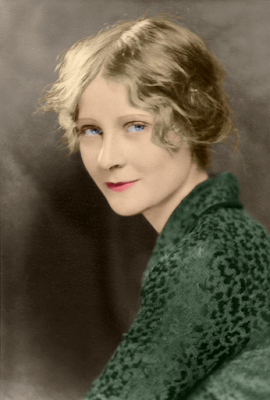
Accomplished stage actor Peg Entwhistle, whose tragic
death has become integral to Hollywood legend and lore.
Also, she was going through a very messy divorce, one that got nastier by the day and dragged on, even after the divorce was finalized.

It is true that she was cast in, and almost entirely cut out of, an RKO Studios film, Thirteen Women. It should be noted that Peg is still in the film while Woman #12 and Woman #13 were cut from the film entirely (how did they not rename it to Eleven Women?).

One night in 1932 she left her uncle’s house on Beachwood Drive, telling him that she was going to walk down to the drug store. Instead, she embarked on 4.5-mile hike up into Griffith Park where she reached the Hollywood sign and located a workman’s ladder that was propped up against the 50-foot-tall letter “H.”

Taking one last look down onto Hollywood, ironically with the RKO Studios Headquarters (currently the Pantages Theater) directly in front of her, she leapt to her death. Also, what’s usually not reported accurately, is that she did not die instantly. The fall was approximately 150 feet into a wooded ravine that resulted in a crushed pelvis, which left her immobilized and dying slowly.

What’s commonly observed over the last 90 years is the vision of Peg on her death march up Beachwood Drive, through Griffith Park and to the Hollywood sign. Even people visiting the Griffith Observatory have looked along the mountain’s ridge to the Hollywood sign where they see a figure take a suicidal leap. Authorities are called, search and rescue crews arrive, but a body is ever recovered.

I told the story to a skeptical friend in Los Angeles as an example of a residual hunting. I explained that the concept isn’t that this woman is continuing to kill herself over and over again, but for whatever unknown reason, the intensity of her emotional turmoil has somehow scarred the land where this event took place. Today, countless unsuspecting bystanders are able to catch a glimpse of the replay of this event. To my surprise, my skeptical friend said, “I can see that.”

In the span of one story, this person went from being a non-believer regarding everything paranormal, to being fully open to one of the most common types of hauntings—the residual haunting.

To continue with my own experience here, there’s a great group called GHOULA (Ghost Hunters of Urban Los Angeles) that conducts all sorts of paranormal meetups throughout Southern California. Each September, on the anniversary of Peg’s suicide, they organize a hike up to the Hollywood sign. I partook in the event in 2013. While I didn’t believe there was a conscious haunting at this site, I figured since I was heading up there anyway, I might as well bring along some ghost hunting gear!

While several small things happened throughout the night, there is one moment that still blows my mind. We waited for most of the group to retreat down the mountain at sunset. All that remained was me and three other people. By sheer coincidence, one of the members of our small group worked at Warner Bros. Studios, which is now the studio that owns the rights to Thirteen Women. Attempting to appeal to the driven actor, during an EVP session, I mentioned, “Our friend here works at Warner’s. It’s still a big production company doing huge pictures. Would you be interested in meeting more people that work at Warner Bros.?”

A hike to the Hollywood sign on the anniversary of Peg Entwhistles
death produced an unmistakable spirit voice. Photo by Scott Markus.
Nearly immediately I thought I heard a whisper but could not make out any words. Upon playback of the audio you can clearly hear a feminine voice say, “Yes.” Unlike most EVP evidence, this didn’t sound like a whisper or a hard-to-make-out raspy hiss. This was clearly a voice firmly saying, “Yes.”

But that wasn’t all! For the next minute and a half, you can hear someone slowly breathing in and out, as if their lips were nearly pressed against the microphone of the recorder. All of this is on video, and you could see that the recorder was held at about waist level in the middle of our group—no one was near the microphone. The vocal EVP and somewhat unsettling breathing were not picked up by any camera mics, just the voice recorder.

Amazingly, Peg Entwhistle’s biographer, James Zeruk, Jr., who was in the process of working on a book about Peg’s life (not a paranormal one), reached out to me and, without solicitation, said, “That was absolutely Peg’s voice you captured.” His book, Peg Entwistle and the Hollywood Sign Suicide: A Biography, was released shortly after this investigation. (The investigation video can be viewed at: www.youtube.com/watch?v=TRSsyoI4RkU.)

Lessons to Take Away from the Experience

While a lot of the previous “lessons” involve making the best of a bad situation or knowing how to not get mired down in someone else’s chaos, this wonderful story shows me that sometimes people might assign themselves to a specific affiliation, but actually don’t have strong convictions behind it. In fact, they may be completely open to taking in new information and making new decisions. The lesson here for me is to remember that as much as I am open to having my mind changed and having my viewpoints challenged, there are other people out there who are still excited about learning and growing as well.

Scott Markus has been researching the paranormal for more than half his life. He is a published author, having written the historical/paranormal book, Voices from the Chicago Grave. His work in both production and the paranormal includes two documentaries on the unexplained and running www.WhatsYourGhostStory.com. He has been interviewed multiple times for Travel Channel’s Mysteries at the Museum and founded the LA Hauntings Tour Co., which lead people through haunted Hollywood and downtown LA.

“Telling Ghost Stories to Skeptics, Part 3,” Copyright 2020 Scott Markus
Monday, October 19, 2020

Guest Post: Telling Ghost Stories to Skeptics, Part 2, by Scott Markus

Note from Amelia: Welcome back Scott Markusfellow author and storyteller, tour guide, podcast host, presenter, investigator, and friend. I had the honor of being interviewed on Scott's podcast, The Fantastic Story Society, in 2019. For the past week and the next two weeks, Scott is sharing his perspective on the art of storytelling, particularly the delicate art of ghost-storytelling to skeptics, while sharing a few of his own ghost stories along the way:

This is the second in a series of three posts that center around telling ghost stories to skeptics and the lessons I’ve learned in the process as a storyteller and tour guide. In these posts, you hear some real ghost stories and the sometimes outlandish ways people attempt to pour cold water on them.

Asking about “Orbs” / Bachelor’s Grove / Setting a Trap for the Over-Believer

The American Horror Story house in Los Angeles, California.
Photo by Scott Markus. 
When I was running the LA Hauntings Ghost Tour company, some of my favorite experiences would be when a private group bought out the whole tour for themselves. That way, I would be able to customize the tour to meet whatever interest that group had. Several years ago, when the show American Horror Story was new, I had a birthday party group to lead around and they wanted to stop by the main house that was the focus of Season One.

Sometimes, however, the worst part of being a tour guide is doing a private tour where the decision-maker of the group wants to go on a ghost tour, but no one else in the group wants to. In this case, there was a birthday girl who loved ghost stories, dragging around a dozen friends who just couldn’t wait to get to the bar. One of the friends was a very outspoken skeptic who did not hide the fact that she really didn’t want to be there.

While everyone else got out of the van to take photos of the American Horror Story house, she decided to stay in the van and ask me what I perceived to be a “gotcha’” question.  She asked me, “What do you think about orbs?”

As I’m sure you know, orbs are a very common phenomenon that appear as floating spheres in still images and video taken at haunted locations. The problem with orbs is that there are countless ways that these anomalies can appear on camera. They pop up as bugs, dust, smoke, rain, snow, and even during high humidity. However, it appears as though sometimes orbs are present when an actual paranormal event happens, too. Therefore, you can’t dismiss all orb images as false positives. You have to take each image or video clip on a case-by-case basis.

I believe a photo or video containing an orb is not evidence in and of itself, but if that moment is captured while something else significant is going on, like an EMF detector going off or even a personal observation of feeling watched at the same time an orb appears on camera, then that orb image has significance to me.

I conveyed this while also telling her a story about when my cousin and my mom were visiting the famously haunted Bachelor’s Grove Cemetery in Midlothian, Illinois. At one point, they thought they felt a cold spot but didn’t want to leap to any conclusions, so they found me to report this. By sheer luck and coincidence, someone took a photo of them as they were walking away from that cold spot. When the film was developed, you could very plainly see an orb was floating in the air behind themright where they thought they felt that cold spot! To me, this is one of the most outstanding orb photos I’ve ever seen, because it’s paired with the personal observations of two people.

This is not an uncommon question to have to address, so I am fairly well rehearsed with this response. I feel that it’s level-headed and practical. I realize any response that gives credibility to orb images will not jive well with a skeptic, but at least this response doesn’t come off as someone who is overreacting to every little thing.

In my years running this tour company, I had only gotten one negative review ever. And that review came from this person. To my total surprise, the review stated that I didn’t give enough credibility to orbs as paranormal phenomena!

Lessons to Take Away from the Experience

Scott’s cousin and mom, with a mysterious orb, at Bachelor’s Grove
Cemetery in Midlothian, Illinois. Photo by Scott Markus.
I think the biggest lesson here for me was to not pre-judge someone’s motivations based on knowing very little about them. I knew this person was a skeptic and she was fairly confrontational in her tone and body language, but taking the mindset that she would be “out to get me” was not helpful. Just because someone claims to be a skeptic, doesn’t mean they’re a non-believer in everything. Maybe this person was actually interested in and excited about orbs, but I leaned too hard on playing it safe.

 Also, I wouldn’t change anything about the content of my message, since I spoke my mind to what I truly believe. However, I was likely not confident in my tone and language, as I may have been trying too hard to play it safe. (If you'd to see more of me celebrating or debunking paranormal photos, orbs and otherwise, check out this video: www.youtube.com/watch?v=9NhBtoYEHJ0.)

I always believe it’s great to ask people, “What do you think?” But I don’t believe I did that here. Who knows, it could have led to a pretty interesting conversation. As paranormal investigators, we go out of our way to try to listen to any communication from a deceased person we hope is in the room with us; however, it’s good to extend that common courtesy to the flesh and blood people we’re actually conversing with as well!

Intense Gettysburg Hauntings and the Intensely Absurd Skeptic

One of my favorite stories to tell when people ask me about a real ghost story I’ve experienced centers on my first-ever visit to the Gettysburg Battlefield on my birthday in 2012. I always point out that it was my birthday to show that this event happened in December, and not a high tourism season, a time when a reenactment would be likely, or even on the anniversary of any of the fighting, which took place over July 1-3, 1863.

If you haven’t been there, the Gettysburg battlefield is an absolutely must-visit location for every American. The three-day battle was the bloodiest engagement of the Civil War and ended up being a turning point in favor of the Union’s eventual victory.

Today, you can go to the Visitor Center and purchase a guided tour on CD to listen to as you spend the day driving around the different significant locations throughout the battlefield. Yep, this is how I spent my birthday!

Near the end of the day, we found ourselves at the sight of “Pickett’s Charge.” This was effectively the site of the Confederate’s last-ditch effort to break through Union lines, led by Maj. Gen. George Pickett and two other generals under Robert E. Lee’s command. Around 12,500 Confederate soldiers charged across three-quarters of a mile of open fields, forcing Union forces back behind a small stone wall. It was this stone wall, poetically, built by slaves, that allowed Union soldiers to repel the Confederate advance. This area is known as the “high watermark” of the Confederacy during the Civil War. The Confederacy never got any further north than this location.

The site of Pickett’s Charge on the Gettysburg Battlefield
in Gettysburg, Pennsylvania. Photo by Scott Markus.
I was here with a group of five people, but by the time we got to this later stop on the tour only one person still wanted to get out and look around with me. After taking our time to breathe in the history of the area, we paused for one last moment of silence before heading back to the car. That silence was broken by the unmistakable sound of three cannons firing, one shot after the next, in the distance! Of course, I was standing there with a video camera in my hand… On pause.

I began rolling after the fact, but nothing but silence followed. At first. After a very long beat, we again decided to return to the car, except I continued to roll on my camera just in case. Soon, the booms of distant cannon fire filled the air again. Quickly, it was joined by the lighter “pop” sounds of gunfire. The amount of artillery fire built and built until you could not hear individual sounds anymore… It was just a cacophony of noise.

Fortunately, the location of where the sound was coming from, was where we had just come from. So, we knew there were no events or reenactments going on in that location. Also, it was late in the day on a drizzly, cold December evening, so there were really no tourist events happening anywhere while we were in town.

When we got back in the car and hit “play” on our guided audio tour, we were amazed to find out that the origin of the fighting at Pickett’s Charge began in the same location we had heard the canon and gunfire sounds. It was also the largest barrage of artillery fire the world had ever seen up to that point…and we were able to witness what it sounded like!

I was recently at a family function and a family friend was excited to talk to me about ghost stories.  This is one my favorite stories to tell because it is so amazing and, in truth, maybe the most exciting event I have ever witnessed.

Upon telling the story, a third wheel (of course) rolled up and threw a lot of “what if” scenarios my way. “Are you sure there weren’t speakers underground?” “Maybe there were speakers hidden inside of trees.” “You can’t be sure that the monuments around Gettysburg aren’t rigged with some sort of electronic devices.”

These are all claims or questions that I could not dismiss out of hand, because, I admit, I didn’t take metal detectors to the trees and I didn’t use ground-penetrating radar to look under the surface of the battlefield on a hunt for speakers. However, I tend to enjoy when skeptic takes this approach. When their “explanations” are this far-fetched, they actually make a supernatural answer seem grounded and logical.

Lessons to Take Away from the Experience

While I am never out to “prove” anything, it’s not uncommon for a skeptical person to try and prove my story false. This actually works in the storyteller’s favor, as I have the lone advantage of being the person in the conversation who actually observed the event, while they are throwing “Hail Mary's” from the sidelines. And, in this case, there’s video to confirm my observations. Meanwhile, the naysayer has to grasp at increasingly outlandish leaps of logic to try to cast doubt on the event.

It's the nature of having a paranormal experience. With or without evidence, every element of a paranormal story will always be left to interpretation. I’m always impressed by how Travis Walton, the famed alien abductee, whose story inspired the movie Fire in the Sky, recounts his experience. He doesn’t know if it was aliens, or the government, or something else altogether. He just knows his scattered memories and the results of numerous investigations into his story, but he doesn’t try to assign any more meaning to things than that. A “just the facts, not the conclusion” approach.

It’s important to stay centered, remembering that you are just telling a story, not trying to win an argument, which can keep everyone on civil footing. I think even skeptics will give you the benefit of the doubt, believing that you are being honest if you aren’t pushing too hard with an air of trying to prove a point. They may think you are mistaken, but they won’t think you’re lying. Small victories.

In my next installment, I will talk about one of Hollywood’s most famous ghost stories, which I feel privileged to have been able to witness firsthand.  I’ll also relay one of the rarest types of story in my arsenal…one where a skeptic becomes a believer!

Scott Markus has been researching the paranormal for more than half his life. He is a published author, having written the historical/paranormal book, Voices from the Chicago Grave. His work in both production and the paranormal includes two documentaries on the unexplained and running www.WhatsYourGhostStory.com. He has been interviewed multiple times for Travel Channel’s Mysteries at the Museum and founded the LA Hauntings Tour Co., which lead people through haunted Hollywood and downtown LA.

“Telling Ghost Stories to Skeptics, Part 2,” Copyright 2020 Scott Markus

Monday, October 12, 2020

Guest Post: Telling Ghost Stories to Skeptics, Part 1, by Scott Markus

Note from Amelia: Welcome Scott Markusfellow author and storyteller, tour guide, podcast host, presenter, investigator, and friend. I had the honor of being interviewed on Scott's podcast, The Fantastic Story Society, in 2019. For the next three weeks, Scott will share his perspective on the art of storytelling, particularly the delicate art of ghost-storytelling to skeptics, and share a few of his own ghost stories along the way:

One of the things I love most about ghost stories is that they are a way to unite people. When I was just starting out in the late ’90s, I would frequently come across the stat that about 1/3 of Americans believed in ghosts. It wasn’t long before I was going from library to school to whoever wanted to book someone to tell stories, giving speeches. For a while I’d start my speech by asking my audience, “Who here believes in ghosts?” I found it amazing that even here, an event about ghost stories, that ratio remained: only about 1/3 of the audience believed in ghosts. I ended up finding comfort in that. Whether you’re a believer or not, everyone likes to hear a good story.

I should take this moment to mention that, inspired by Amelia Cotter’s weekly storytelling sessions at the beginning of quarantine, I started telling ghost stories every Wednesday night over at www.facebook.com/WhatsYourGhostStory. In addition to telling themed ghost stories each episode, I also have a question of the week for the audience, which isn’t anything paranormal and more importantly, it’s never anything political. One of my big goals in life lately is to remind people that we all share in a million human experiences and that we’re far more alike than we are different. Loving ghost stories? That’s almost universally a human experience. Almost.

That said, not every occasion of telling a ghost story to a non-believer has gone smoothly. Though extremely rare, sometimes a skeptical listener actually is there with ill-intent. In all cases, there was a little lesson to learn. So, I’m going to share with you a couple of my own ghost stories, how certain people attempted to get in the way of each story, and, hopefully my pain can be your gain if you ever find yourself in a similar situation.

Paranormal Investigation at the Tribune Tower and the Party Pooper

The Chicago Tribune Tower at 435 N. Michigan Ave.
Photo by Scott Markus.
When you’ve spent the majority of your life visiting haunted places, you tend to get invited to parties as the unofficial (unpaid) entertainment. At one party, the hostess was an avid fan of ghost stories. During a lull in conversation, I was asked to talk about a recent adventure I’ve had. The timing was good because I had just had the unreal experience of having the run of one of Chicago’s most iconic skyscrapers – the Tribune Tower. (You can view the edited video of our investigation here: www.youtube.com/watch?v=xr9X0KqaxWk.)

The Chicago-area stand-up comic Patti Vasquez has long been a good friend of mine and when she got her own show on WGN Radio, we found more ways to have adventures together. She’d usually have me on her show around Halloween where I’d tell stories and take calls for an hour. One time, she lined it up so we could investigate the building her late-night show wrapped for the evening. It was around 2 a.m. once her show wrapped.

Located right in the heart of Chicago on Michigan Avenue, we began our paranormal search in the “showcase studio.” It’s a Today Show-style street-level studio with big wraparound plate glass windows. The production team had recently lost one of their crewmembers to a heart attack and still wondered if famed broadcaster Bob Collins, who died years earlier in a plane crash, might be in hanging around after death in this space. The studio seemed very peaceful, still, and quiet, so we eventually moved on to other parts of the building. There is a meeting room, which is where Chicago Tribune reporters would take important interview subjects to conduct their hard-hitting pieces. According to the team, this is the room where many a big name was brought to their knees, their corrupt careers brought to light. This seemed to be the most active location on our night. We experienced cold spots, voices that came over the spirit box, and perhaps an actual voice in the room, to go along with some small EMF hits. Based on what he heard about the room, there could be a lot of emotional energy left behind. 

As another aside for what might make this location haunted, the Tribune Tower is incredibly unique in that its ground floor, inside and out, has artifacts embedded in it from around the world. There’s a piece from the Great Pyramid, a rock taken from the site of the lost colony of Roanoke, pieces of the Taj Mahal, the Parthenon, Angkor Wat, Lincoln’s tomb, Notre Dame Cathedral, and, more recently, a piece of the World Trade Center Tower wreckage. There’s more than a hundred more pieces including small rock samples taken from the site where Christ was born. If you can go along with the idea that a place can hold a spiritual energy charge, the Tribune Tower has gathered energies of unique sites from all around the world to this one location.

We talked to the overnight security team to find out if they have any stories and they pointed out to us locations that they did not like to patrol. One was a stairwell very high up in the building. It was exciting to view this location because we could see very quickly that the EMF readings were extraordinarily high here due to the wiring. High EMF can affect our perception to the point of feeling uncomfortable or paranoid. I believe we found a practical reason to rule out that location being haunted. However, we fully understand why the security team did not want to spend more time here than they needed to. 

Cornerstone of the Chicago Tribune Tower.
Photo by Scott Markus.
My favorite part of the night was when the security guards took us to the floor they find the most unsettling. According to them, there was a suicide on this floor and a negative entity remains. You can actually see in the video I posted on YouTube that the security guards bring us up to this location, but before we could ask many questions, they had already abandoned us…getting out of Dodge as soon as possible! Sometimes I find human reactions to things to be some of the biggest “evidence” of a haunting.  I didn’t see anything paranormal, but you could see their fear and that was significant to me.

So, Back to Me Telling This Story at a Party…

The woman who was sitting next to me couldn’t have been less interested in hearing it. She certainly had the option to get up and walk away, and I wish that she had. However, in staying, she took it upon herself to roll her eyes and loudly scoff at every statement. She would try to put me on the spot and call me out on minor details like, “Well, what floor was it?” Always striving to tell an honest story, I responded, “I don’t remember off the top of my head, but it’s in the video, which is published on YouTube, if you really want the answer.” At this, she found another opportunity for a big eye roll and a gesture around the room as if to say, “See, I told you this was all a lie.”

First off, how does that prove anything? I could’ve said any number in response to her question, and she wouldn’t know any different. Had I confidently said a number, would that have proven to her that the story was true? Of course not. Just for the record, it’s the 24th floor.

I never take the approach of “trying to prove something” while telling a story. I simply approach it like a journalist would approach a news story. I state the facts, interview witnesses, research, and try to be clear in my descriptions. This woman’s pushback was so strong that the instinct for me as the storyteller was to elevate to her level of intensity in an argumentative way. Fortunately, that’s not my style and I tried to be the bigger person by ignoring her and simply addressing everybody else in the room who was interested in the story. However, the heckler completely undercut everyone’s enjoyment.

Lessons to Take Away from the Experience

For the most part, I’m happy with how I handled things, but there was still room for improvement. If you’re dealing with someone who is aggressively against you and taking an active role in belittling you, it’s good to not feed that energy. Stay true to the story you were going to tell and focus on the people are having a good time.

That said, I think I should have called out the uncomfortable situation live, as it was unfolding. “Why are you acting so mean?” I have to imagine that calling out her behavior in an innocent way would have ended the situation immediately. Hopefully, I will not have a Take 2 to test this option in the future.

In the next two installments, you will get ghost stories about locations ranging from the Hollywood Sign to Gettysburg, and the sometimes surprising ways people react to them.

Scott Markus has been researching the paranormal for more than half his life. He is a published author, having written the historical/paranormal book, Voices from the Chicago Grave. His work in both production and the paranormal includes two documentaries on the unexplained and running www.WhatsYourGhostStory.com. He has been interviewed multiple times for Travel Channel’s Mysteries at the Museum and founded the LA Hauntings Tour Co., which lead people through haunted Hollywood and downtown LA.

“Telling Ghost Stories to Skeptics, Part 1,” Copyright 2020 Scott Markus

Monday, October 5, 2020

Guest Post: The First Ghost Hunter, by Allison Jornlin

Note from Amelia: Welcome Allison Jornlin, fellow writer and storyteller, tour guide, presenter, investigator, and friend. She shares this fascinating account of the life and work of Catherine Crowe, also known as the first ghost hunter! Learn more about the adventures of Catherine Crowe and other trailblazing women of the paranormal on Allison’s YouTube channel, Paranormal Women: A Hidden History:

The only known image of Catherine Crowe, ca. 1840s. 
Picture the intrepid paranormal investigator. Does he flush out his prey via outbursts of angry, baritone machismo? Or, is he a polite monitor of an array of blinking, beeping, technical gadgets? Does he wear a skin-tight muscle shirt, slick suit, lab coat, or workman’s overalls? Wait a minute. Is HE a man at all?

The original paranormal investigator was, in fact, a woman, although you’ve probably never heard her name. Catherine Crowe (1790-1872) could be called the mother of the paranormal. There were no doubt others before her who were interested in strange phenomena and even those who put together collections of true ghost stories, but Crowe went way beyond merely collecting tales.

Even a casual reading of her 1848 opus The Night-Side of Nature reveals not just ghost stories but other paranormal tales, which clearly don’t fit that mold. Crowe’s 400-page book includes a variety of unexplained phenomena including what we now call OBEs, NDEs, time slips, and ESP. Catherine Crowe’s work has influenced every single one of us in today’s paranormal arena. You just don’t know it yet.

Crowe compiled and compared cross-cultural data about a wide variety of strange phenomena. She was one of those rare multilingual researchers who scoured the literature of non-English speaking countries for anomalies. Inspired by German scholars in particular, Crowe brought the ideas of leading physicians, physiologists, and other scientists, including Justinus Kerner and others too numerous to mention, to English-speaking readers.

You’re familiar with the words “poltergeist” and “doppelgänger” because she introduced the terms and concepts to English usage. Crowe also investigated hauntings in a manner we would still recognize today. In 1854, for example, she organized a party of witnesses to investigate a notoriously haunted house in Edinburgh, Scotland. She enlisted a clairvoyant and several esteemed members of the community to make contact with the spirits of those murdered on the premises and dutifully recorded their experiences. Crowe and the clairvoyant observed “waves of white light” emanating from the floor in intervals. Crowe and another witness glimpsed “a bright diamond of light, white brilliant and quiescent.” This paranormal investigation was likely the first of its kind.

Catherine Crowe penned The Night-Side of Nature. Or, Ghosts and Ghost Seers in 1848, a time when women didn’t have the right to vote or own property or do much of anything on their own. Nevertheless, Crowe persisted. She became an independent woman, living in Edinburgh, who left London and her husband to pursue her dream of becoming a writer. Challenging convention she interviewed witnesses, pioneered paranormal investigation techniques, and investigated sĂ©ance circles decades before Harry Houdini was even born. The Night-Side of Nature, published just as the Spiritualist movement was getting underway, rocketed Crowe to fame. Night-Side blazed a trail with 16 editions in just six years.

A Train of Ghosts, by Hablot Knight Browne, UK. Ca. 1865.
Catherine Crowe had a message for the world for which she used every means in her power to convey. She was inspired to do her own investigations of strange phenomena after much reading on the topic and translating one such work called The Seeress of Prevorst in 1845. The book was written by well-respected German physician Justinus Kerner as a case history of his extraordinary patient Friederike Hauffe. Hauffe was a medium who spent most of her life in trance states overcome with prophetic dreams and visions of spirit communication. The Night-Side of Nature was meant to foster the budding field of psychical research by providing a categorical record of dreams, presentiments, warnings, trances, wraiths, apparitions, spectral lights, haunted houses, poltergeists, and other revelations, together with an appeal for the serious scientific investigation of all such phenomena.

Writer and paranormal researcher Colin Wilson called The Night-Side of Nature “the first sustained attempt to treat paranormal phenomena in the scientific spirit that would later characterize the Society of Psychical Research.” Almost 35 years after its publication, the SPR would continue Crowe’s work by adopting many of her methods.

“We have an indefeasible right to investigate every question that presents itself to our intellects; and it is not only a right, but an urgent duty, to investigate one that so nearly concerns our well-being here and hereafter,” Crowe writes. She condemned both “pharisaical skepticism which denies without investigation” and “blind credulity which accepts all…without inquiry.”

She sought an objective approach to paranormal investigation and was able to identify and distinguish between many types of unexplained phenomena. Many findings commonly misattributed to contemporary researchers can be found in Crowe’s writing.

For example, Crowe has a surprisingly modern-sounding take on poltergeist phenomena. If Crowe is known at all, she is most often just credited with introducing the term poltergeist into English, but she hypothesized about them a great deal, looking for possible causes. Poltergeists (“ racketing specter” in German), she says, can scarcely be reconciled to our typical notions of “what we understand by the term ‘ghost’” due to the “odd, sportive, mischievous nature of the disturbances.” Crowe maintains that these nonsensical incursions into normal reality have been reported in all countries and all ages. Although, throughout the centuries, poltergeist activity has been ascribed to many different causes including ghosts, witchcraft, demons, and fairies, Crowe ascribes them most often to a human agent. In the 20th Century, parapsychologists Nandor Fodor and William G. Roll suggested that poltergeist activity might be caused by psychokinesis. However, Crowe proposed something similar in 1848.

In The Night Side of Nature, she relates several cases of teen girls who have been beset with wild talents that include the ability to deliver electric shocks, in one recorded instance, even remotely and purposefully. One such human agent of this strange phenomenon was a young lady living in Strasberg, Germany, identified only by the surname Emmerich. Crowe relates that “her body became so surcharged with electricity, that it was necessary to her relief to discharge it.” Unfortunately, this strange malady soon claimed her life. Crowe speculates that these strange circumstances may be connected to some form of electricity or displaced energy. “We begin to see that it is just possible the other strange phenomena [related to poltergeist activity] may be provided by a similar agency.”

Much of Crowe’s work still resonates today. Orbs, shadow people, time slips, twin telepathy, and every variety of precognition all feature prominently in her writing. The anecdotal evidence, which Crowe collected for nearly every type of strange phenomena, laid important groundwork. Fortunately, others, like the researchers of the Society for Psychical Research, followed in her footsteps and began accumulating the necessary data to build a stronger foundation for future discoveries. Crowe’s primary objective was “to induce a few capable persons, instead of laughing at these things, to look at them.”

To learn more about the adventures of Catherine Crowe as well as other forgotten female trailblazers of the paranormal, subscribe to the new YouTube channel Paranormal Women: A Hidden History.

Allison Jornlin has been investigating strange phenomena for more than 20 years. She developed Milwaukee’s first haunted history tour in 2008. Since then Allison has led numerous tours and presented talks on a variety of Fortean topics—poltergeists, fairies, UFOs, cryptids, demonic possession, etc. Allison currently works as a professional weirdo, writing articles for a variety of publications, developing haunted history tours for AmericanGhostWalks.com, and awaiting the birth of her first book.

The First Ghost Hunter, copyright 2020 Allison Jornlin

Wednesday, August 7, 2019

Guest Post: Witchcraft in Chicago's Stockyards, by Michael Kleen

Note from Amelia: This is my 50th blog post! And to celebrate, I'm letting another blogger do all of the work. Welcome Michael Kleenwriter, photographer, fellow storyteller, and longtime friend. I had the honor of hosting Michael's documentary, Tinker's Shadow: The Hidden History of Tinker Swiss Cottage. He shares this fascinating story and partial excerpt from his unique volume on an oft-overlooked topic in Midwest lore, Witchcraft in Illinois: A Cultural History:

At the turn of the twentieth century, Chicago was known as a hub for the meat packing industry. Thousands of immigrants, particularly from Eastern Europe, flooded into the southwest side Back of the Yards neighborhood to work at the Union Stock Yards. Upton Sinclair famously wrote about this area in his 1906 novel The Jungle.

These immigrants, mainly Bohemians, Moravians, and Slovakians, brought their folk beliefs with them when they came to the Windy City, including a strong belief in witchcraft. We will never know how many accusations, confrontations, and strained relationships this belief caused, but occasionally an accusation of witchcraft made its way to the courthouse and into the press.

Victor Sleeth was an assistant superintendent for Armour & Co., the meatpacking company that defined Chicago’s Back of the Yards neighborhood. Armour & Co. opened in Chicago in 1867 and by 1910 employed over 8,700 people at the Union Stockyards. Victor’s 22-year-old wife, Mary, had contracted consumption. She was in the advanced stages of the disease when her sister, 21-year-old Augusta Wilke, an assistant foreman at Armour & Co., called in a 50-year-old nurse named Mary Vogel.

Vogel attended to Mary Sleeth for a month, until Mary died on February 2, 1919. On Monday, February 24, William L. Sehlke, a masseur and husband to Mary Vogel’s other sister, Martha, went to the Stockyards police to ask for warrants for the arrest of Mary Vogel and Augusta Wilke.

William and Martha Sehlke told the Chicago Daily Tribune an incredible tale. According to the Sehlkes, Mary Vogel was a witch and Augusta Wilke was her understudy, and they sought protection from her slander and sorcery. Augusta allegedly told Martha that Mary Vogel believed Martha was a witch and had poisoned her sister for the benefit of two other witches, a Mrs. George Hellman and Mrs. Marian Sleeth, a widow and Mary Sleeth’s sister-in-law.

In turn, Martha accused Vogel of being a witch. Father Phillips of the Franciscan Fathers of St. Augustine Church told reporters he went to Victor and Mary Sleeth’s home, where he found Vogal burning salt in the oven and incense in the rooms. “She was making motions with her hands, and I told her to get out, and she did,” said the priest.

According to Martha Sehlke, “Mrs. Vogel was burning salt and incense. She got a lamb’s heart and put some new pins in it and burned it. This was to find out which of us ‘witches’ would be around that day and to cast a spell over the one that would come.” After her sister’s death, Martha alleged that Vogel sent for William Wilke, her brother-in-law, and a week later he died.

Public record does not reveal if this dispute was ever resolved, but it demonstrates a continued association between witchcraft, sickness, poison, and a breakdown in social relations. The traditional tools of witchcraft—incense, salt, pins, organs—remained in use even in industrial-era Chicago following the First World War.

Was the proceeding case an isolated incident, or does it reveal an undercurrent of belief in magic and witchcraft in early-twentieth century Chicago? In 1903, the Chicago Daily Tribune investigated this question and concluded, “That more people believe in witches in Chicago than ever believed in them in Salem, or any of the other witch centers of old, sounds like a joke, but it is a solid fact.”

Based on cases investigated by the Chicago Police, the Tribune concluded Chicago was home to not hundreds, but thousands of believers. The strange case of Mary Vogel and Augusta Wilke is a fascinating glimpse into that world.

Michael Kleen is a writer and photographer with an interest in history and the unusual. He has written several books, including Witchcraft in Illinois: A Cultural History, and directed the documentary Tinker’s Shadow: The Hidden History of Tinker Swiss Cottage.

"Witchcraft in Chicago's Stockyards," copyright 2019 Michael Kleen

Monday, October 29, 2018

Guest Post: The Figure on the Heath, by Tim Gardiner

Note from Amelia: I reached out to friends and followers in hopes of gathering some true ghostly encounters to share each week during the month of October. Last week, we heard from Nanette Fabros about an unsettling experience in an old apartment. This week, I would like to conclude the round of creepy tales by welcoming ecologist, poet, and children's author Tim Gardiner, who shares this detailed encounter and analysis from Little Baddow Heath in Essex, England:

I have been recording glow-worms Lampyris noctiluca on Little Baddow Heath in central Essex for over a decade. The Essex Wildlife Trust nature reserve comprises ancient woodland intersected by bridleways with a small area of open heathland nestled in the middle. On Friday 11th July 2014 I was accompanied by Laura Jane Weir and we were searching the open heathland for glow-worms when we both noticed a white figure (approximately 50 m distant as determined from a follow up daytime site visit) on the edge of the heathland at around 10.30 pm. We had no torch (artificial light makes seeing glow-worms more difficult) and our eyes had been accustomed to the dim light for approximately 40 minutes. At first we thought it was a deer (either fallow Dama dama or muntjac Muntiacus reevesi) due to the light colour of the figure.

We decided to investigate and moved closer to the white figure which appeared to correspondingly move towards us making no discernible sound as it passed over the ground. As we got closer it became clear that it was a white, cloudlike shape, with an indistinct form. We stopped around five metres from the figure and noticed that it was constantly changing shape but no features were clear, although it was not transparent. It was pitch-dark, with a little natural light on the open heathland to illuminate the figure which we could see was approximately one metre in height. The figure’s features were indistinct (we could not see a face for example) with no recognisable attributes of human or animal form. Distinctly unnerved we decided to leave the heathland and search other parts of the woodland for glow-worms. We came back at around 11 pm to see if the figure was still there but it had disappeared.

Discussing it on the drive home we debated the possible rational explanations for the white figure we had seen. Misperceptions of natural phenomena are behind many supposed sightings of ghosts. The most obvious misperceptions (in no particular order of likelihood) in this case are as follows:

1. A deer. This seems extremely unlikely as the figure made no sound as it moved towards us. A deer crossing ground would disturb vegetation making some sort of discernible noise. We also got very close to the figure and it did not run away as a deer would normally do if close to a human presence. The figure also had no definite shape as a deer would have.

2. A swarm of insects. The constantly changing shape suggests that a swarm of insects (possibly moths) may have been the cause of the figure and would also account for its apparent movement. However, it is rare to see a swarm of moths and other insects such as bees would probably make a discernible buzzing noise.

3. Marsh gas or mist. The white shape did appear to be cloudlike with an indistinct shape like mist or marsh gas (will o' the wisp). However, it did not glow as marsh gas does and it was not a misty night ruling out these as likely explanations. The shape also appeared to move towards us which marsh gas or mist would not do. It was a humid night though; perhaps this could have produced some form of atmospheric anomaly?

4. A birch Betula spp. tree stump. One possible explanation is that the figure was just the misperception of a white birch tree stump observed in poor light conditions leading to the perception that the tree stump moved when in reality we were moving towards it. A visit to the site at 3.30 pm on 17th July 2014 found a one metre high birch stump in the approximate location of the sighting. Nearby a shorter birch tree stump (less than 50 cm tall) had a 1.5 metre high young birch tree behind it and the leaves were swaying in the wind which at night could have been misperceived as a moving figure set against the backdrop of the dull white stump. The stumps remain the most likely natural cause of the sighting.

5. Reflection or shadow from a light source. The night was overcast with no moon ruling out lunar reflections off vegetation or the ground. There are no artificial light sources within several hundred metres of the heathland and any light would have had to penetrate dense woodland to reach us, which is not very likely.

6. Hallucination. The fact that two people saw exactly the same thing rules out delusions of the mind.

The strong mitigating factor for the observation was the poor light conditions. The dim light meant that our vision was undoubtedly impaired; however, our eyes had been accustomed to the darkness for at least 40 minutes as we wanted to maximise the chances of seeing glow-worms. With this adjusted vision we still could not make out a clear shape for the figure and it is easy to misjudge object distance and movement in poor light conditions. There was also the problem of expectation due to the spooky nature of the site, although neither of us was expecting to see a "ghost" as we were focused on the glow-worm survey. I have surveyed the site alone many times in the last decade and have never witnessed any unexplained figures or shapes before.

Daytime reconstruction

One of the most important facets of paranormal investigation is to undertake a daytime visit to a site to determine possible reasons for the phenomenon i.e. it could be xenonormal which is something which appears paranormal but has natural causes. A daytime survey was undertaken on 17th July at 3.30 pm to determine the exact location and environmental conditions of the sighting. On the visit, a one metre high birch tree stump was present in the approximate location of the sighting and could be seen from a distance of 50 metres. Nearby a shorter birch stump (less than 50 cm in height) had a young birch tree growing behind it and was swaying in a gentle breeze. It is possible that this may have accounted for the apparent movement of the white figure when we got within five metres of it. Therefore, the movement of the figure may have been down to misperception of the shorter tree stump in the poor light conditions. No other features on the heath were seen which could have been misperceived as a figure in poor light.

Conclusion

Taking into account all of the above logical explanations and information from the daytime reconstruction, it is probable that we experienced some kind of misperception of a natural phenomenon such as the birch tree stumps. The least likely explanations based on the rationale presented above and the daytime reconstruction includes a misperceived deer, mist/marsh gas, shadow and a swarm of insects. The possibility of hallucination was ruled out as the figure was seen by two witnesses. This leaves only the possibility of misperception of the birch stump and swaying tree caused by poor light conditions. We will never be sure of what we saw on the heath on 11th July but the sighting must go down as a likely case of the xenonormal instead of a genuine paranormal experience.

Dr. Tim Gardiner is an ecologist, poet, and children's author from Manningtree in Essex, UK. His haiku have been published in literary magazines including Frogpond, Modern Haiku, and The Heron's Nest. His first collection of poetry, Wilderness, was published by Brambleby Books in 2015, while a second, On the Edge, appeared in 2017. Tim's debut children's book, The Voyage of the Queen Bee, was published by the Bumblebee Conservation Trust in 2016.

"The Figure on the Heath," copyright 2018 Tim Gardiner (first published as "White Enigma" in Fortean Times Issue 323 in 2015, and as "The figure on the heath" in Essex Field Club Newsletter No. 76 in 2014)